For investors
Floating hotels work. Location determines the return.
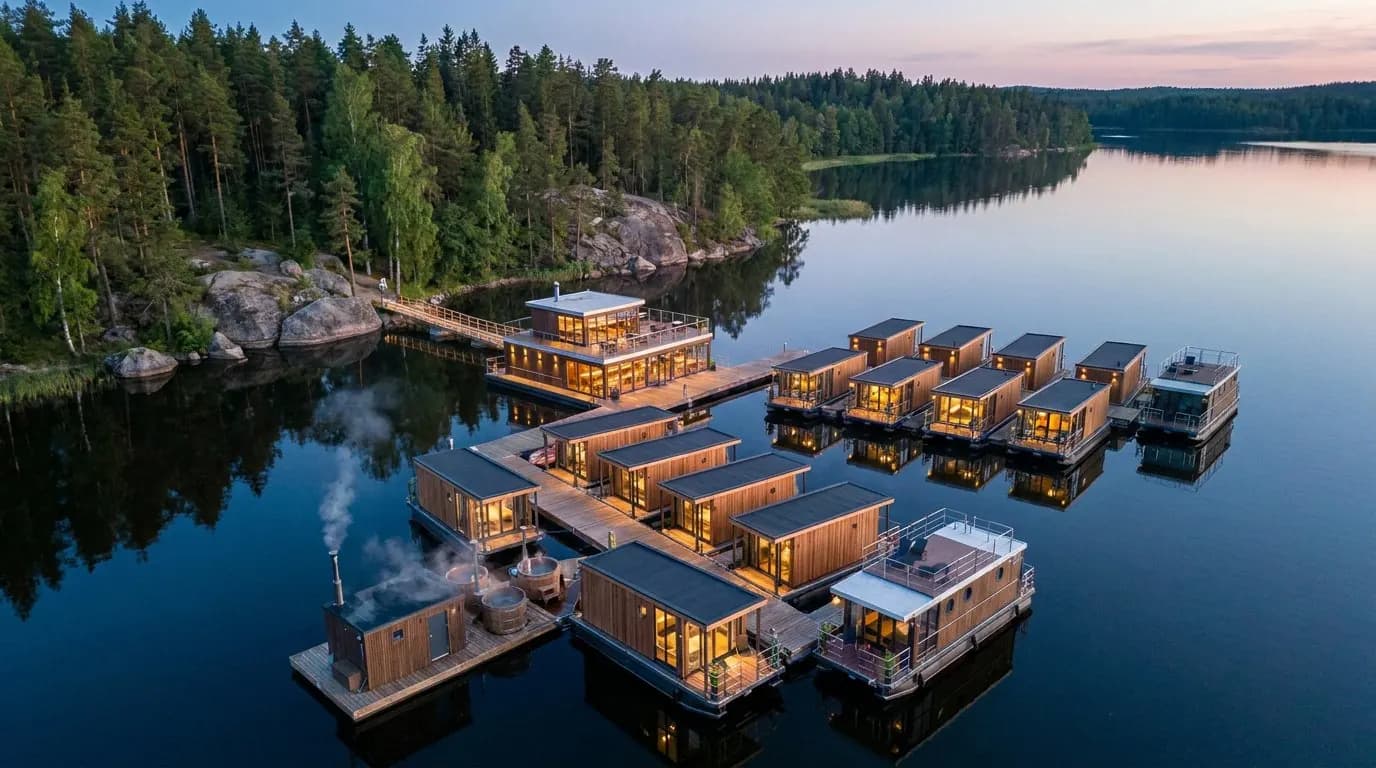
Floating hotel rooms are already proven in Northern Europe: CPH Living in Copenhagen has 12 rooms on a converted barge, and Sweden has Salt & Sill and Arctic Bath. We apply the same concept using road-transportable modules, so it also works on inland lakes.
City or southern resort
Long seasons and higher rates. In our reference model, these sites generate the highest return per euro invested.
Existing hotel or marina
The restaurant and reception are already in place, so a light hub is enough and the investment per room is lower.
Seasonal lake
Strong summer, weak winter. Works best as a smaller project or next to an existing resort.
The feasibility study includes a revenue model for your site: rates, occupancy, operating costs and financing. Indicative figures are neither a forecast nor an offer.
Permits and risk
The main risk lies in permits, not construction
Permits
At a permanent mooring, a floating hotel is usually treated as a building. That means zoning for the water area, a building permit and often a water permit for piling. We prepare the technical documentation.
Seasonality
Managed through the right choice of site, winter offers in the north and phased growth from 20 to 30 rooms.
Asset flexibility
Modules can be added, moved to another site or sold. This makes a floating hotel easier to adapt than a building on land.
From site to first guests
How a project runs
- 1
Site
Location, water depth, shoreline, utilities
months 0–3
- 2
Feasibility
Layout, budget, revenue model
months 2–6
- 3
Permits
We prepare the technical documentation
months 4–12
- 4
Prototype
One Villa Duo on your site
months 5–11
- 5
Production
Factory build, 16–24 weeks
months 10–16
- 6
Installation
Transport, mooring, start-up
months 16–18
Questions investors ask
FAQ
Is a floating hotel a building or a boat?
At a permanent mooring, it is usually treated as a building, so you need zoning for the water area and a building permit. Rules vary by country and municipality. We prepare the technical part of the application.
Can it operate in winter and in ice?
Yes. The villa bodies are insulated for year-round use, water pipes are frost-protected and bubbler systems keep the water around the units free of ice. Ice loads are calculated for each site.
Can it be installed at sea?
Yes, in a sheltered bay or a marina protected by a breakwater. The Mediterranean edition uses marine-grade fittings, and the mooring is sized for storms and seasonal winds.
What happens to wastewater?
Nothing is discharged into the water. Every unit is connected by a pressure sewer to a pumping station in the hub, and from there to the municipal network or a treatment plant.
What returns can an investor expect?
That depends far more on the location than on the buildings. City and southern resort sites earn the most; a seasonal lake site calls for a smaller project or an existing resort nearby. The feasibility study includes a revenue model for your site.
Can the village be moved or extended later?
Yes. Modules can be added, moved to another site or sold, which keeps the asset flexible.
Start with your site
Request a feasibility study
Tell us about the site and your plans. We will reply with initial questions, a draft layout and our investor concept document.
sales@nordicseason.eu
+358 40 164 6168
Prices and specifications are indicative and subject to change. Visualisations are illustrative.